Phone:

扫一扫添加官方微信

Applicable to gravity-flow pipelines such as municipal sewage pipes, combined sewer pipelines and inspection wells
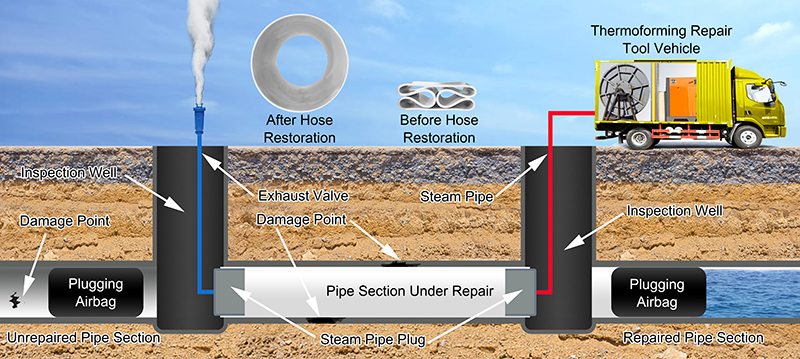
Process Principle
For special-shaped gravity pipes (such as reducing pipes, irregular pipe sections, elbow pipes), hoses made of thermoplastic materials are heated and softened by in-situ thermoplastic curing construction equipment, then pulled into the pipes, and cooled and shaped by the pipe's own temperature and external cooling equipment to closely fit the inner wall of the original pipe and form a sealed and smooth liner layer.
Core Features
Thermoplastic materials have high flexibility, can perfectly adapt to the irregular shape of special-shaped pipe sections, and solve the pain points of special-shaped pipeline rehabilitation that are difficult to cover by traditional processes; the liner layer is resistant to acid and alkali corrosion, suitable for sewage media in sewage pipes; no chemical volatiles during construction, high environmental friendliness, suitable for the rehabilitation of special-shaped sewage pipe sections in urban areas.
Process Principle
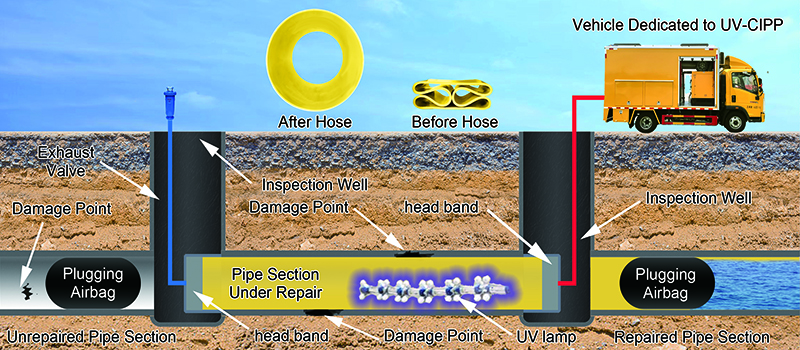
Pull the glass fiber hose impregnated with unsaturated polyester resin into the to-be-repaired sewage pipe by traction equipment, make the hose closely fit the inner wall of the original pipe by air pressure, and then irradiate it with UV light tubes to quickly cure the resin to form a high-strength and smooth liner pipe to replace the original pipe for flow passing.
Core Features
The inner wall of the liner pipe is smooth, and the flow efficiency is 15%-20% higher than that of the original pipe, which meets the core demand of gravity drainage; the cured liner pipe has high strength, corrosion resistance and leakage prevention, with a service life of up to 50 years; it has little impact on road traffic and is the core process for the overall rehabilitation of municipal sewage pipes.
Process Principle
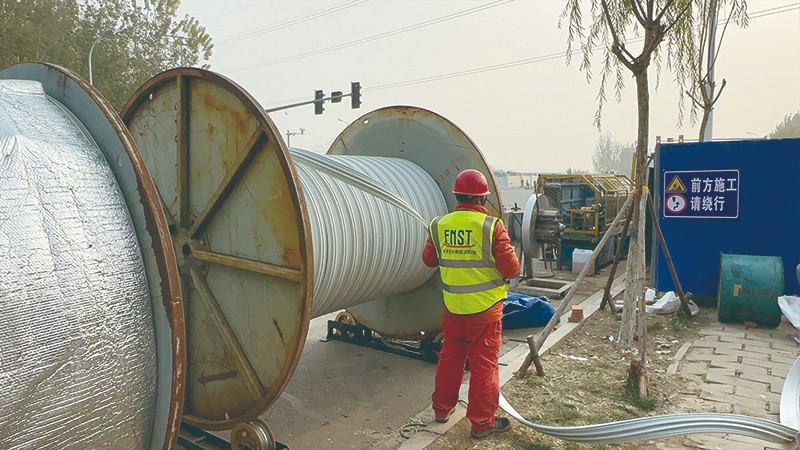
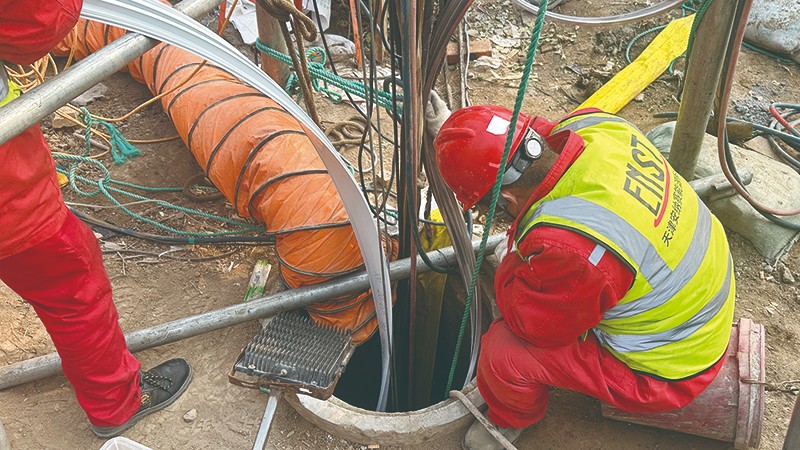
Form the strip composite material into a spiral wound shape on site in the sewage pipe through special winding equipment, the locks are interlocked and sealed to form a complete liner pipe, and cement mortar can be filled between the liner pipe and the inner wall of the original pipe for fixation to ensure structural stability.
Core Features
Fast winding speed, suitable for the overall rehabilitation of long-distance gravity pipes; the lock seal structure has good anti-leakage effect, avoiding groundwater pollution caused by sewage leakage; the inner wall of the composite material is smooth, ensuring flow efficiency, and is wear-resistant and corrosion-resistant.
Process Principle
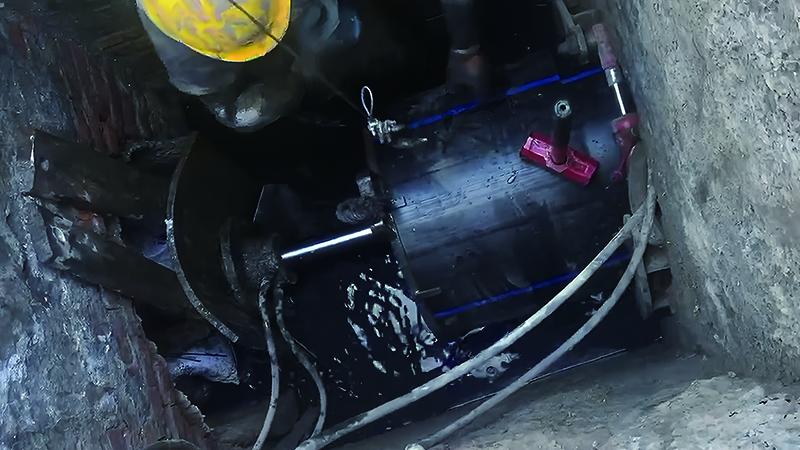
For major defects such as severe corrosion, collapse and rupture of pipelines, modular pressure-bearing short pipes are adopted. Through trenchless traction/jacking equipment, the damaged section of the old pipe is replaced with a new pressure-bearing short pipe without excavating the ground, and the interface is treated with sealed flanges or welding process to ensure pressure-bearing and sealing performance.
Core Features
Accurately replace the damaged pipe section, and the pressure-bearing capacity of the repaired pipe is consistent with that of the new pipe; the length of modular short pipes can be customized, suitable for different damage ranges and flexible in construction; suitable for the replacement and backwashing of pipelines in "no-excavation" areas such as urban trunk roads and dense building areas.
Process Principle
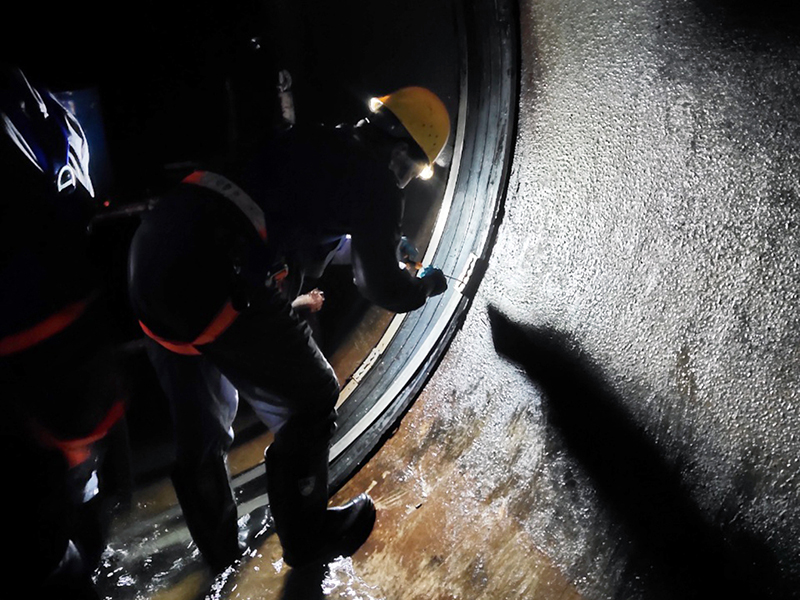
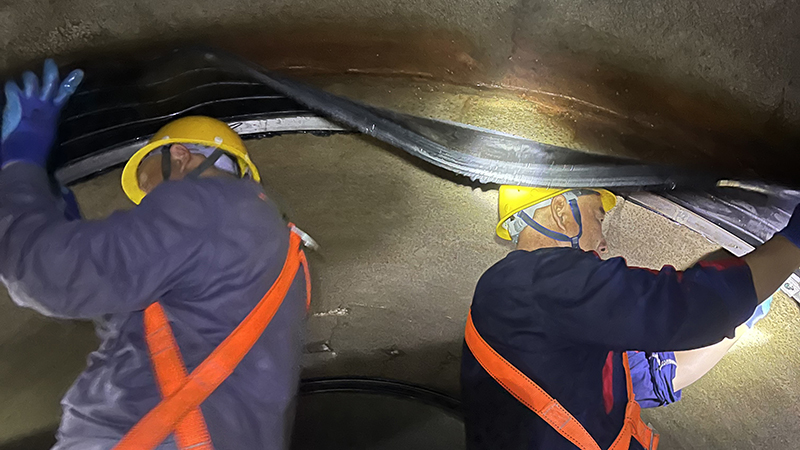
For minor defects such as pipeline interface leakage and local short cracks (length ≤ 50cm), a two-section stainless steel expansion ring is adopted. Fix the expansion ring at the defect on the inner wall of the pipeline with a special tensioning tool, and the sealing rubber strip is compressed to completely fill the gap, forming a double protection of mechanical seal + material seal.
Core Features
Trenchless and fast construction (single interface rehabilitation ≤ 30 minutes); both the expansion ring and the sealing rubber strip are resistant to medium corrosion, and the sealing performance is durable after rehabilitation without subsequent maintenance.
Process Principle
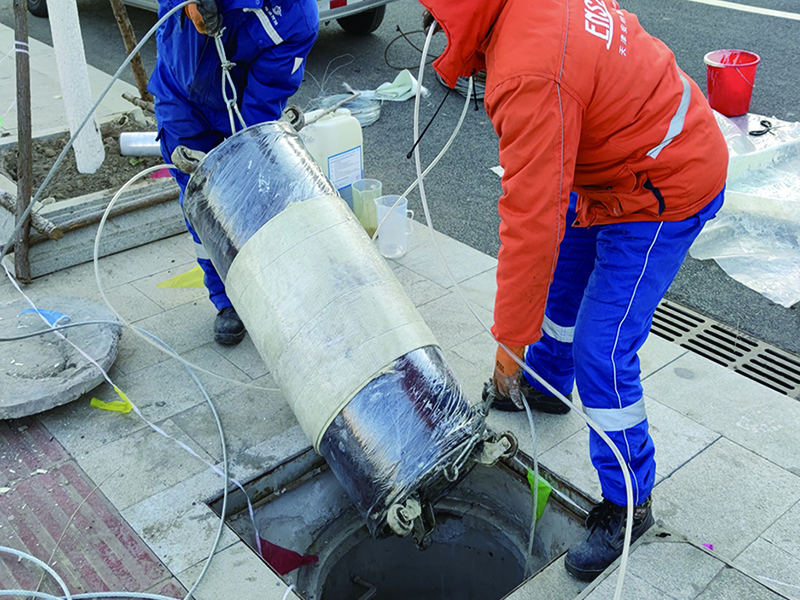
For local minor defects of gravity pipes (such as holes, short cracks, interface leakage, area ≤ 0.5 ㎡), after accurate positioning by pipeline inspection robots or endoscopes, special spot repair materials are adopted, and the materials are compacted at the defects with special plugging airbags or templates, then form a dense sealing layer through room temperature curing; in case of emergency leakage defects, quick lock/stainless steel quick lock tools can be used simultaneously to accurately fasten the prefabricated sealing locks at the damaged parts, realize instantaneous sealing by compressing mechanical bolts, and carry out resin curing and reinforcement when conditions permit in the later stage.
Core Features
The special repair material has strong adhesion to the wall of the original pipe, the strength after curing matches the original pipe, and the sealing and anti-seepage effect is durable; no need for overall pipe section rehabilitation, only precise treatment for defect points, greatly reducing material consumption and construction period, saving 40%-60% of the cost compared with overall rehabilitation; room temperature curing without additional energy, simple construction process, suitable for the repair of sporadic defects after daily inspection of municipal sewage pipes; the quick lock auxiliary process can realize "immediate repair and immediate passage", suitable for emergency repair scenarios such as flood seasons.
Process Principle
For the inspection wells supporting gravity pipes (inner wall corrosion, leakage, falling off), use inspection well centrifugal spraying equipment to uniformly spray modified resin or anti-corrosion mortar on the inner wall of the inspection well by centrifugal force to form a dense and smooth anti-corrosion and anti-seepage layer, the thickness of which can be adjusted according to requirements (usually 3-5mm).
Core Features
Uniform spraying without dead angles, can cover the inner wall of the inspection well and the joint of the pipe orifice, avoiding soil pollution caused by sewage leakage from the inspection well; the anti-corrosion layer has strong adhesion, is resistant to sewage corrosion and scouring, and prolongs the service life of the inspection well; high construction efficiency, suitable for batch maintenance of municipal sewage inspection wells.


Room 402-1, Building B, Phase I, Haitai Green Industry Base, No. 6 Haitai Development 6th Road, Huayuan Industrial Zone, Binhai High-Tech Zone, Tianjin

After-sales Service:022-58387760
Room 402-1, Building B, Phase I, Haitai Green Industry Base, No. 6 Haitai Development 6th Road, Huayuan Industrial Zone, Binhai High-Tech Zone, Tianjin
After-sales Service:18902036337
market@enstline.com
© 2026 Tianjin Energy Solution Technology CO., LTD. All Rights Reserved. Powered By TengYun